
You just topped up at a highway parking lot with the only available canister, an ACEA C3 oil, while your maintenance booklet specifies a C4. The oil warning light has turned off, but one question remains: can this mixture damage your engine or your particulate filter?
SAPS and additives: what really separates a C3 oil from a C4
Competitors often talk about “compatibility” without explaining the root of the problem. It boils down to one acronym: SAPS (sulfated ash, phosphorus, sulfur). These elements come from the anti-wear and detergent additives present in the oil. When the oil partially burns in the combustion chamber, these additives leave solid residues.
An ACEA C3 oil is classified as mid-SAPS: it contains a moderate level of these additives. An ACEA C4 oil is classified as low-SAPS: the content of ash, phosphorus, and sulfur is significantly lower.
Why does this difference matter? Because SAPS residues accumulate in the particulate filter (DPF). A DPF designed to operate with low-SAPS oil does not tolerate a regular influx of additional ash well. This ash does not burn off during regenerations; it remains permanently trapped in the filter.
On the other hand, a point often overlooked: since the ACEA 2023 sequences, C3 and C4 share the same minimum HTHS viscosity threshold (high-temperature high-shear viscosity). Therefore, the mechanical protection of the oil film is identical between the two standards. The difference lies solely in the chemistry of the additives.
Before deciding to mix ACEA C3 and C4 oil, it is important to understand that the risk is not an immediate mechanical failure, but a gradual degradation of the pollution control system.
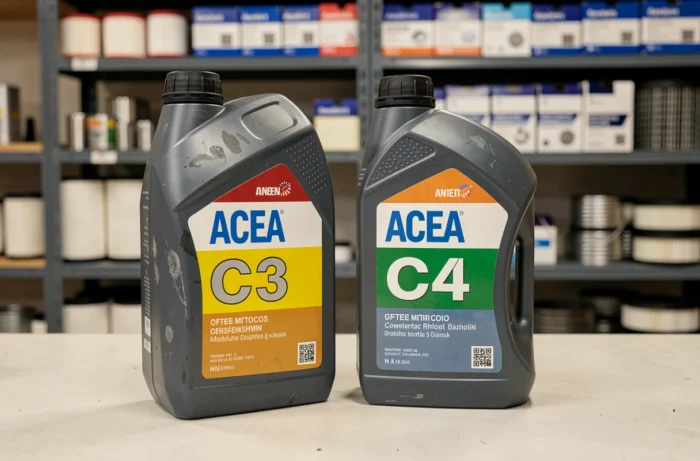
Mixing C3 and C4: what your DPF actually endures
Imagine a sump filled with 80% C4 oil and topped up with 20% C3. The lubricating film remains effective, the engine runs without any suspicious noise. The problem is invisible in the short term.
The resulting mixture no longer meets the C4 specification. The content of sulfated ash exceeds the low-SAPS threshold. Every kilometer traveled deposits a bit more residue in the DPF than what the manufacturer had planned.
Why some engines are more sensitive
Vehicles that require C4 oil typically have a pollution control system finely calibrated. This is the case for certain Renault engines (manufacturer standard RN0720) or Mercedes (MB 226.51). These engines use DPFs whose channels are sized for minimal ash accumulation.
A DPF clogged with non-combustible ash does not regenerate. Regeneration cycles eliminate soot, not mineral residues. Over thousands of kilometers, exhaust back pressure increases. The engine loses performance, fuel consumption rises, and the DPF eventually triggers an alert.
The case of emergency top-up
A one-time top-up of C3 in an engine designed for C4, over a few hundred kilometers before the next oil change, does not cause measurable damage. The volume added is small compared to the total volume of the sump. The dilution of SAPS additives remains marginal.
Performing a complete oil change as soon as possible eliminates the risk. The problem arises when the mixture becomes the norm, oil change after oil change.
C3 oil in an engine designed for C4: common mistakes to avoid
The case from the Caradisiac forum illustrates the catastrophic scenario well: a 2012 Renault Trafic diesel DPF receives C3 oil instead of the prescribed C4 during a service package. Less than a month later, DPF alarm, oil alarm, clogged oil filter. The diagnosis concludes with an engine out of service.
This extreme case likely combines several factors (oil quality, prior condition of the engine). C3 oil alone does not explain a failure within a month. However, it may have accelerated a latent problem by overloading an already weakened DPF.
The most common mistakes:
- Entrusting the oil change to a car center without specifying the exact standard. The 5W30 viscosity is correct, but the ACEA specification may not be. A 5W30 ACEA C3 canister and a 5W30 ACEA C4 canister look visually similar
- Relying solely on SAE viscosity without checking the ACEA standard or the manufacturer standard (RN0720, MB 226.51, etc.)
- Using C3 oil “by default” because it is easier to find and cheaper, without considering the specific requirements of the vehicle
Manufacturer standard and ACEA standard: which takes precedence for oil choice
The ACEA standard defines a common technical baseline. But each manufacturer can impose additional requirements. Renault, Mercedes, or PSA publish their own validation codes.
The manufacturer standard always takes precedence over the ACEA standard. If your booklet indicates RN0720, the oil must carry this approval. An ACEA C4 oil that does not carry the manufacturer code does not guarantee total compliance.
In practice, most oils approved by a manufacturer for C4 use also bear the ACEA C4 mention. The reverse is not true: not all ACEA C4 oils are approved by every manufacturer.
Checking the correct reference takes thirty seconds. Three reliable sources:
- The vehicle’s maintenance booklet, often with a specific code in the first pages
- The oil filler cap under the hood, which sometimes mentions the viscosity and standard
- The technical data sheet of the oil canister, which lists the manufacturer approvals on the back of the label

The C3/C4 mixture does not destroy an engine overnight. The real danger lies with the DPF and the pollution control system, not with the lubrication itself. An emergency top-up with the “wrong” standard is still preferable to driving with a low oil level.
The simple rule: top up if necessary, then drain as soon as possible with the oil prescribed by the manufacturer. When entrusting your vehicle for an oil change, demand the exact standard, not just the correct viscosity.