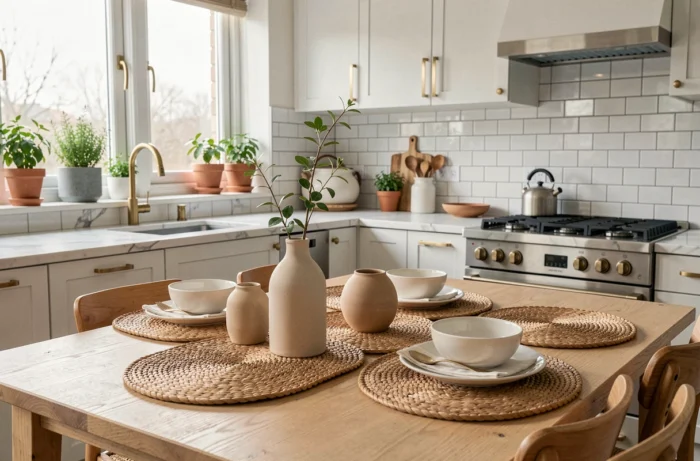
CallMeSpring structures its decor proposals around a logic of continuity between the kitchen and living room. Rather than treating each room as an isolated volume, the brand promotes a cross-sectional reading of materials, shades, and functions. Here, we decode the technical axes that deserve the attention of professionals and discerning individuals.
Connection of kitchen-living room materials: the junction that determines everything
The most structuring trend at CallMeSpring concerns the management of transitions between two open spaces. When a solid wood countertop visually extends a TV unit or a living room console, the choice of wood species and finish becomes a technical parameter, not just aesthetic.
A wood treated differently in the kitchen and living room creates a visual break that most projects underestimate. Oiled matte oak withstands food splashes well, but its patina quickly diverges from that of a varnished oak in the living room. We recommend selecting a unique finish (hard oil or matte varnish) for both volumes, then adjusting the maintenance frequency according to usage.
Acoustic decorative wood panels, increasingly present in CallMeSpring’s proposals, raise the same question. A laminated panel placed on the living room wall to absorb reverberations can extend into a kitchen backsplash, provided a food-compatible waterproof treatment is applied. This material continuity is the common thread found in CallMeSpring trends and news for several seasons.
CallMeSpring color palette: balancing earthy tones and mineral greens
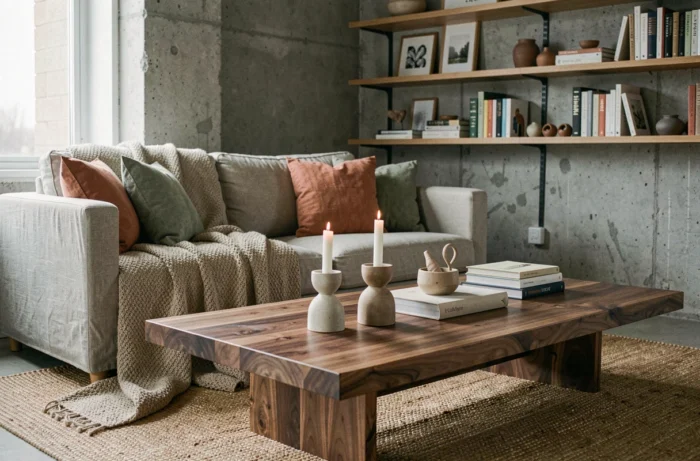
Natural shades dominate CallMeSpring’s artistic direction. Warm brown, sandy beige, sage green, eucalyptus green: the palette remains stable from one season to the next, reflecting a sustainable positioning rather than a fashion effect.
The technical challenge lies in coordinating colors between two very different lighting zones. The color temperature of the fixtures radically alters the perception of sage green depending on whether viewed under a 4,000 K kitchen LED spotlight or a 2,700 K living room pendant. The same RAL can appear grayish in the kitchen and distinctly green in the living room.
To avoid this discrepancy, we observe that the most successful projects use a dominant neutral shade (beige or greige) on large surfaces, reserving pronounced greens or browns for accent elements: island fronts, cushions, high stool seats. This approach limits unpleasant surprises related to lighting variations and remains consistent with CallMeSpring’s logic of visual continuity.
Integrated lighting and design: the often under-specified aspect
CallMeSpring highlights atmospheres where lighting seems natural, but the technical reality behind these renderings is more demanding. A unique kitchen-living room lighting plan avoids dead zones and harsh contrasts at the boundary between the two spaces.
Three points deserve special attention during design:
- The line of recessed spots above the countertop should align with the rail or pendants in the dining area to create a continuous ceiling perspective.
- LED strips under the kitchen upper cabinets benefit from being controlled by the same dimmer as the living room’s indirect lighting, to synchronize light levels in the evening.
- The choice of a CRI (color rendering index) above 90 across all sources ensures that wood materials and wall shades remain true from one room to another.
These technical details condition the success of a CallMeSpring-inspired interior much more than the choice of a trendy color.

Energy renovation and decoration: an underutilized intersection
Kitchen-living room redesign projects offer a window of opportunity to couple decoration and thermal performance. The relaxation of MaPrimeRénov’ by gesture, extended until January 1, 2026 by decree n° 2024-1143, allows for requesting assistance for an insulation gesture without necessarily linking it to a heating change.
In practice, an insulating lining covered with decorative wood panels can be eligible for MaPrimeRénov’ while serving as an aesthetic support in the living room. The DPE is no longer required at the time of file submission under this transitional scheme, simplifying the process for owner-occupiers.
This intersection between energy renovation and decoration remains absent from most mainstream decor content. CallMeSpring trends, which value natural materials and wood panels, lend themselves particularly well to this. Combining a renovation budget with a decor budget allows for amortizing part of the cost of noble materials against public aid.
Modular furniture and open layout: what CallMeSpring implies in practice
The open kitchen-living room layout requires furniture capable of playing a dual role. A central island serves as a preparation surface, storage, and space separator. CallMeSpring pushes this logic with pieces featuring clean lines, often in light wood, that integrate well into both culinary contexts and reception spaces.
The depth of the island conditions its actual use. Below 90 cm, the seating on the living room side becomes uncomfortable. Beyond 120 cm, the island encroaches on circulation and disrupts the fluidity advocated by the brand. Precise sizing, adapted to the available area, takes precedence over visual effect.
Open shelves, another CallMeSpring signature, require a level of organization that most households underestimate. They function as a showcase on the living room side but accumulate grease and dust on the kitchen side. Positioning open shelves exclusively on the living room wall and keeping closed fronts on the cooking side remains the most realistic compromise.
Enhancing an interior from the kitchen to the living room according to CallMeSpring’s codes relies less on the choice of a color or style than on mastering the junctions: junction of materials, junction of light, junction of thermal. It is these implementation details that separate a coherent interior from a mere assembly of trends.