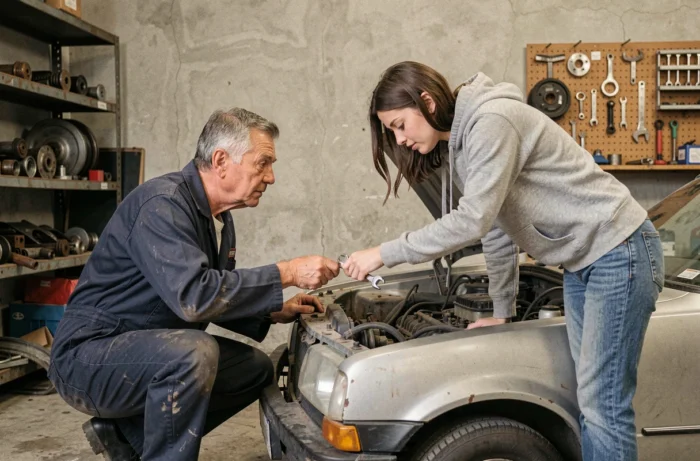
In France, mobility remains a prerequisite for accessing a job, pursuing training, or simply receiving medical care. In areas poorly served by public transport, being unable to repair one’s car often means losing a job or giving up a job offer. Solidarity garages attempt to address this deadlock by offering repairs at reduced prices, but their model is not limited to a discount on the bill.
Family quotient pricing: when the community sets the repair rate
The classic associative model offers a single rate, often half that of a traditional garage. Some communities go further by integrating the solidarity garage directly into their local mobility policy.
In Compiègne, a public and solidarity garage directly funded by the community applies hourly rates that vary according to the household’s family quotient. The cost of labor thus varies from one user to another, which distinguishes this system from associative structures where the price is the same for all eligible beneficiaries.
This operation raises a question of scope. A garage funded by public funds can offer lower rates than an association that relies on occasional grants and donations of parts. However, it remains subject to municipal budgetary decisions, which makes its sustainability less predictable. The structures listed on garages-solidaires.fr help identify the various available options according to the territories.
Reintegration through automotive mechanics: the case of Douai
Repairing at a lower cost is just one aspect of the solidarity garage. The other, less visible, concerns the professional integration of the people who work there.
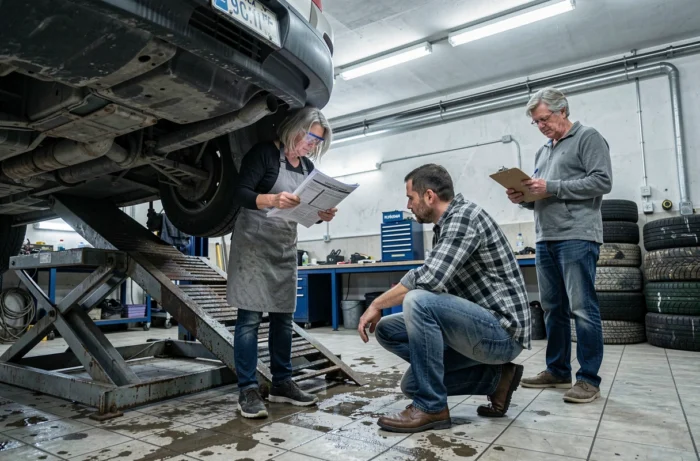
In Douai, a solidarity garage opened in 2026 by the association Le Gap (establishment La Bouée des Jeunes) welcomes educators and young people in integration who use mechanics as a support for re-mobilization. The participants are not just volunteers: they follow a structured program where automotive repair serves as a pretext for punctuality, teamwork, and the acquisition of technical skills.
This type of structure differs from a self-garage, where the driver comes with their tools and leaves once the oil change is done. Here, the primary goal is not the repair of the client’s vehicle, but the reconstruction of a professional path for the young person working on it. The vehicle repaired at a solidarity price is a byproduct of the integration process.
Limits of the educational model
Entrusting a mechanical intervention to a training audience raises questions of quality and responsibility. A dispute reported in a solidarity garage in Saône-et-Loire reminds us that diagnosis remains a technical act requiring verifiable competence. When a supervising professional oversees each operation, the risk decreases. When they are absent or overwhelmed, the beneficiary may end up with an incomplete repair.
The quality of supervision varies greatly from one structure to another: some integration workshops boast a high satisfaction rate thanks to strict monitoring of each intervention, while others struggle to recruit qualified mechanics willing to accept the salary scales of the social and solidarity economy.
Access conditions for solidarity garages in France
Access to solidarity garages is not open to everyone. Most structures impose eligibility criteria that vary from one network to another.
- Referral by a social prescriber (social worker, local mission, Pôle emploi advisor) required in the majority of garages in the Solidarauto network
- Income ceiling or specific situation (RSA beneficiary, job seeker, temporary worker on assignment via Fastt)
- Annual membership in the association, with fees ranging from a few euros to a more substantial contribution depending on the structure
These filters exist to focus resources on the most vulnerable populations. They effectively exclude modest workers who exceed the thresholds but cannot afford a traditional garage bill. The solidarity garage does not cover the entire gray area between precariousness and the middle class.

Solidarity automotive maintenance and sustainable mobility: convergences and tensions
Extending the lifespan of an old vehicle through accessible maintenance contributes to a circular economy logic. Repairing rather than replacing reduces waste production and limits the extraction of raw materials. The Solidarauto network explicitly claims this sustainable dimension in its model.
Tension arises when the repaired vehicle is an aging diesel, potentially subject to traffic restrictions in low-emission zones. Maintaining a polluting vehicle can conflict with local environmental objectives. For the precarious driver, there is no choice: they drive with what they have.
Some solidarity garages are beginning to offer the sale of refurbished used vehicles, sometimes newer and less polluting. This complementary activity remains marginal due to insufficient stock and dedicated funding.
Impact on employment: a measure still absent
There is no consolidated assessment measuring the impact of solidarity garages on return to employment at the national level. Figures circulate structure by structure, without a common methodology. As long as this evaluation is lacking, the model relies on individual testimonies and the conviction of field actors, not on a global statistical proof.
- No national observatory centralizes activity data from all solidarity garages
- The link between vehicle repair and job retention is documented by narratives, rarely by cohorts followed over time
- The communities that fund these structures have not yet harmonized their outcome indicators
The solidarity garage model responds to a real and urgent need. Its ability to transition from the current hundred structures to a dense territorial network will depend as much on public funding as on the availability of mechanics willing to work in this framework. The question is no longer whether these garages are useful, but how to make them accessible where they are most needed.