
Choosing a pruning saw to maintain your garden involves comparing technical data that varies greatly from one type of motorization to another. Battery voltage, engine displacement, guide length, weight: these parameters determine cutting capacity, ease of use, and overall budget. This article measures the concrete differences between the major families of pruning saws to identify what really makes a difference at the time of purchase.
Gas, battery, or corded electric pruning saw: compared technical differences
| Criterion | Gas | Battery | Corded Electric |
|---|---|---|---|
| Power | High (common displacements of 25 to 35 cm³) | Medium to high (18 V to 40 V platforms and more) | Medium |
| Average weight | Heavier (engine + fuel) | Intermediate (battery included) | Lighter (no tank or battery) |
| Runtime | Unlimited as long as there is fuel | Limited by battery capacity | Unlimited (plugged into mains) |
| Noise | High | Low to moderate | Low |
| Maintenance | Filter, spark plug, engine oil, fuel mix | Chain, guide, lubrication | Chain, guide, lubrication |
| Range | Total | Total | Limited by cable length |
The table highlights a often underestimated point: the maintenance of a gas pruning saw is significantly more demanding than that of a battery or corded model. Spark plug, air filter, preparation of the oil-gas mix, carburetor purge at the end of the season. For domestic garden use, this maintenance gap weighs more than the difference in raw power.
The product sheets from specialized catalogs, particularly on elagueuse-warrior.com, allow you to compare these parameters model by model before making a choice.
Battery compatibility: the criterion that changes the price calculation
Traditional buying guides compare the price of the machine. This approach overlooks a crucial factor for cordless pruning saws: compatibility with an already owned battery ecosystem. Between 2024 and 2026, major brands have standardized battery platforms common to their entire range of garden tools (blower, brush cutter, hedge trimmer, chainsaw, pruning saw).
In practice, a gardener already equipped with a brand can purchase the pruning saw as a “tool only,” without battery or charger. The savings represent a significant portion of the total price.
- Check the voltage of your current battery and its compatibility with the targeted pruning saw model (a 36 V tool does not work with an 18 V battery, except for dual-rail systems in some brands)
- Count the number of garden tools planned in the long term: the more the range expands, the lower the average cost per tool thanks to shared batteries
- Examine the battery charging time relative to runtime: a battery that requires several hours of charging for about twenty minutes of actual cutting necessitates owning at least two batteries
This ecosystem reasoning is more reliable than a simple catalog price comparison. Two to three shared batteries among several tools cover the complete maintenance of a garden without multiplying investments.
Classic pruning saw or pole saw: which tool depending on cutting height
The distinction between a classic pruning chainsaw and a pole saw determines the safety and efficiency of the work. These two tools do not serve the same purpose, and confusing them leads to poor purchases.
Classic pruning chainsaw
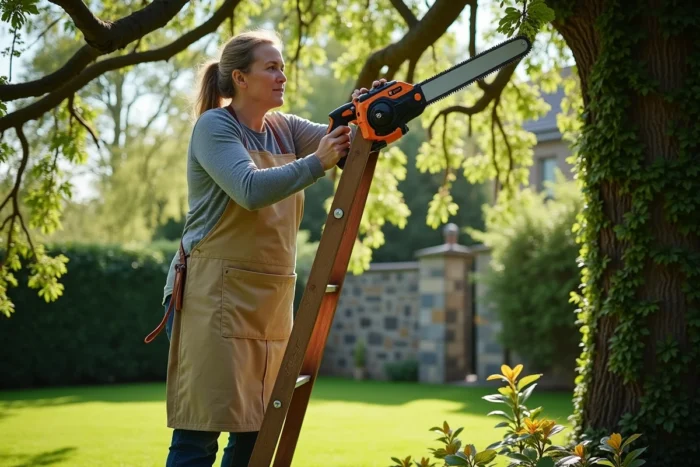
Compact and lightweight, it can be operated with one hand (with harness) or two hands from a ladder or platform. Its short guide bar, usually around 25 cm, is intended for branches of small to medium diameter. The reduced weight is its main advantage for prolonged work at height.
It requires climbing into the tree or onto a support. For an untrained individual, this configuration presents a real risk of falling.
Pole saw for working from the ground
The pole saw (fixed or telescopic) allows cutting branches at height without leaving the ground. The motor is located at the bottom of the pole, which lightens the effort at the end of the arm. Some models with adjustable heads (from 0 to 90°) can reach hard-to-access branches.
However, the pole saw is heavier and less precise than a classic pruning saw for close cuts. The lever arm amplifies fatigue beyond a few dozen minutes of continuous work.
For a garden with trees whose low to medium branches require regular maintenance, the pole saw avoids the need for a ladder. For canopy pruning or fine cuts on shrubs, the classic pruning chainsaw remains more suitable.

Guide length and chain: what determines actual cutting capacity
The length of the guide bar sets the maximum diameter of branches that a pruning saw can cut in one pass. A guide that is too short requires attacking the branch from multiple angles, which wears the chain and increases the risk of kickback.
Garden pruning saws typically use guides ranging from 20 to 30 cm. Beyond that, we enter the territory of classic chainsaws.
- A 20 cm guide is suitable for thin branches and regular maintenance of shrubs
- A 25 cm guide covers the majority of domestic pruning tasks
- A 30 cm guide allows tackling thicker branches but adds weight to the tool
The chain itself deserves attention. A low-kickback chain is recommended for non-professional use. Automatic lubrication of the guide by the integrated oil circuit remains a comfort criterion to check: without it, the chain heats up and dulls quickly.
The rise in power of battery platforms towards voltages of 36 V and 40 V now allows powering guides of 25 to 30 cm without resorting to gas. For a medium-sized garden, a 36 V battery pruning saw with a 25 cm guide covers almost all needs while remaining quiet and easy to maintain.