The choice of equipment for the home and garden is not just about browsing a catalog and checking boxes. Recent regulatory changes, particularly regarding brush clearing, are reshaping the purchasing priorities for a growing number of French homeowners. We review the technical criteria that differentiate a sustainable investment from a purchase that needs to be replaced in two seasons.
Order of April 13, 2026, on brush clearing: what it changes for your garden equipment
Since the ministerial order of April 13, 2026, 52 departments are now classified as fire risk zones, up from 48 previously. Corrèze, Haute-Loire, Essonne, and Seine-et-Marne are among the new departments affected. Homeowners who were not previously subject to the legal obligation of brush clearing must now comply.
This obligation is not limited to a one-time cleanup. It requires ongoing maintenance of the land within a strip that can reach 50 to 100 meters around buildings. We therefore recommend sizing your tool inventory accordingly: a simple shear is not enough when you need to keep a perimeter clear all year round.
To select your home equipment on Brico Déco Jardin, you must first check if your municipality is on the list of areas subject to obligation. If so, the trio of thermal brush cutter, long-reach hedge trimmer, and garden shredder becomes a necessity, not a luxury.
Fences, garden sheds, and wood storage must also be reconsidered. A wood shed placed less than ten meters from the house in a classified area can make the owner liable in the event of a disaster. Outdoor development is now inseparable from regulatory compliance.
Technical criteria for choosing durable gardening tools
The market is full of entry-level tools that attract with their price. In practice, the quality of the steel, the type of fitting, and ergonomic design determine the actual longevity of the equipment.
Steel and surface treatment
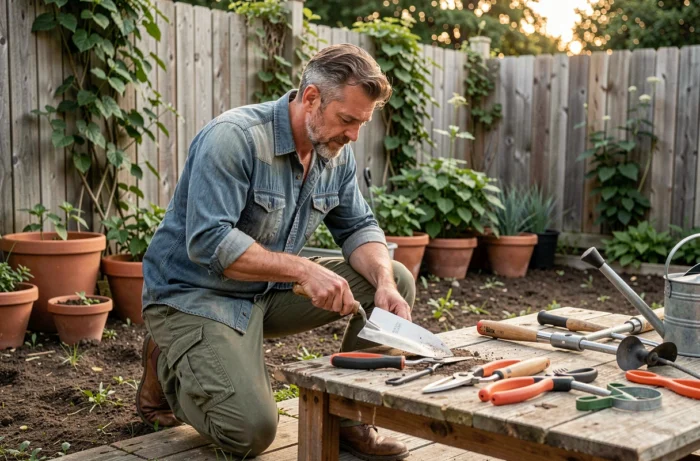
A soil working tool (spade, fork, rake) deserves a blade made of hardened or forged steel. Stamped sheet metal versions deform as soon as the soil offers resistance. A boron-treated anti-corrosion steel lasts several seasons without special maintenance, provided it is stored dry.
Fitting and handle
The ash wood handle remains a reference for vibration absorption. Fiberglass handles offer a lighter alternative, suitable for prolonged work. The critical point is the fitting: a full socket fitting (the handle goes into the blade) can withstand much greater stresses than a tang fitting (metal rod inserted into the handle).
- Spade and fork: prefer the full socket and a handle of at least 90 cm for standing work without straining the back.
- Pruner: check for the presence of a replaceable spring and stainless steel blades. An anvil pruner is suitable for dead wood, while a bypass pruner is for green wood.
- Hedge trimmer: for the new brush clearing obligations, a cutting length of at least 50 cm and the ability to cut branches of medium diameter are necessary.
- Garden shredder: a rotor knife system shreds more quietly and accepts thicker branches than a blade system.
Home equipment: balancing thermal comfort and maintenance
The heating budget remains the largest equipment expense in a home. The choice between a wood insert, a pellet stove, or a heat pump depends on the area to be heated, existing insulation, and the local cost of fuel supply.
An efficient wood insert requires a compliant chimney flue and log storage at a legally required distance from the facade, which directly relates to the brush clearing constraints mentioned earlier. We observe that many homeowners underestimate this link between wood storage and fire risk.
For wet rooms (bathroom, laundry), an air extractor sized to the room volume prevents condensation and mold problems. An extraction rate suitable for the number of water points determines the system’s effectiveness, not the brand or design.

Terrace and garden shed development: materials and soil constraints
Composite wood has largely replaced natural wood for terraces, mainly because it requires neither sanding nor annual treatment. However, its heat behavior deserves attention: some dark composites can reach uncomfortable surface temperatures in full sun.
For a garden shed, the choice of material (wood, metal, resin) primarily depends on the intended use. A shed intended to store powered tools (mower, brush cutter) requires sufficient ventilation to avoid the accumulation of gasoline vapors. An untreated wood shed placed directly on the ground degrades within a few seasons.
We recommend a concrete slab or adjustable footings as a base, regardless of the shed material. Soil preparation is the most often neglected aspect, yet it conditions the stability and lifespan of the entire structure.
Seasonal maintenance: planning purchases according to the calendar
The classic mistake is to buy equipment when it is needed, that is, in the middle of the season, when prices are at their highest and stocks are at their lowest. Pruning tools are better priced in winter. Irrigation systems, on the other hand, are found at better prices at the end of summer.
Brush clearing is best planned in autumn or winter when plants are less leafy and easier to trim. Aligning the purchase of equipment with this calendar allows for testing the tools before the critical season.
A homeowner who invests in equipment suited to the regulatory and climatic constraints of their plot does not spend more. They buy less often. The durability of a well-chosen tool, stored properly and maintained after each use, far exceeds that of two successive low-end tools.