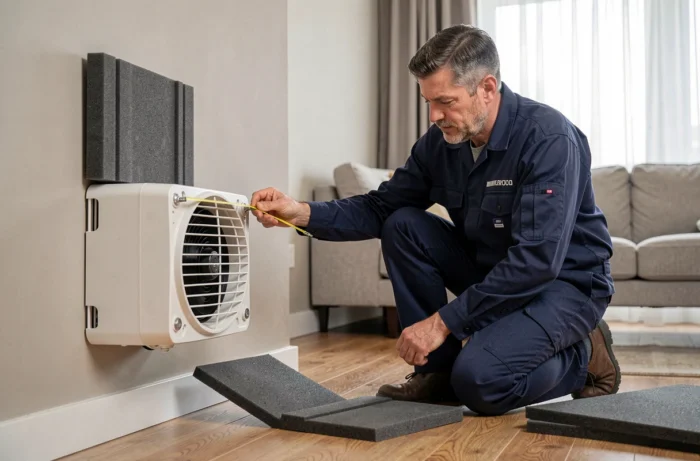
The dull hum of an outdoor air conditioning unit, especially at night, quickly turns a balcony or terrace into a tension zone with the neighbors. Reducing the noise from an air conditioning unit doesn’t always require changing the device. A well-sized acoustic enclosure can significantly lower the perceived noise level, provided you understand where the noise is coming from and how to trap it without suffocating the machine.
Airborne noise and vibrations: two problems, two distinct treatments
Before choosing a soundproofing solution, it’s essential to identify what is producing the noise. An outdoor air conditioning unit emits two types of nuisances that are treated differently.
Airborne noise comes from the fan and the compressor. It propagates through the air, bounces off nearby walls, and amplifies if the unit is installed in a corner or under an awning. This is the humming that the neighbor hears from their window.
Vibrations, on the other hand, travel through the structure. The compressor transmits oscillations to the wall support or the concrete slab. These vibrations spread through the building and can resonate in an adjacent room, even with closed windows.
Installing an acoustic enclosure for air conditioning primarily addresses airborne noise. For vibrations, action must be taken at the mounting point with anti-vibration pads (silent blocks) that decouple the unit from its support. The two approaches are complementary, not interchangeable.

Acoustic enclosure for air conditioning: how it reduces noise without overheating the device
An acoustic enclosure is not just a simple box placed around the outdoor unit. Its principle relies on a ventilated casing whose walls absorb and reflect sound waves before they reach the environment.
The inner wall is typically lined with an absorbing material (melamine foam, high-density mineral wool, or composite foam). This layer captures sound energy and converts it into residual heat. The outer wall, which is more rigid (steel, aluminum, dense wood), forms a barrier that blocks direct transmission.
The classic trap: blocking ventilation
Have you ever noticed that an air conditioner moves a considerable volume of air? The fan of the outdoor unit expels the hot air resulting from the heat exchange. If the enclosure restricts this flow, the internal temperature rises, the compressor works harder, and consumption increases. In the worst-case scenario, the thermal safety shuts off the device.
An effective enclosure maintains sufficient free space around the unit and incorporates calibrated openings, often in the form of acoustic baffles. These baffles create a zigzag path for the air: it circulates freely, but the sound loses energy with each change of direction.
Materials and sound attenuation
The choice of material directly determines the acoustic performance of the enclosure. Here are the most common options:
- Galvanized steel with an absorbing lining: robust, weather-resistant, suitable for condominium installations where durability matters.
- Composite wood or exotic wood: aesthetically pleasing, good absorption if lined with an insulating layer, but requires treatment against moisture.
- Melamine foam sandwiched between two rigid panels: excellent absorption/thickness ratio, often used in industrial enclosures.
A well-designed enclosure can reduce perceived noise by 10 to 20 dB, which corresponds to halving to quadrupling the sound impression for the human ear.
Law of April 15, 2024, and neighborhood disturbances: what a noisy air conditioning owner risks
The legal dimension has changed recently. The law no. 2024-346 of April 15, 2024 has added an article 1253 to the Civil Code that creates strict liability for the owner of a noisy installation as soon as the noise exceeds the normal inconveniences of neighborhood life.
In practical terms, a neighbor no longer needs to prove fault. They only need to demonstrate that the noise from your air conditioning exceeds what can reasonably be tolerated in the neighborhood. The judge assesses the situation considering the intensity, duration, frequency, and context (dense urban area, quiet residential area).
Since January 1, 2024, the acoustic certificate in new buildings has become a mandatory requirement. The acceptable noise level in main rooms is limited to 35 dB(A) for an individual device. This necessitates considering the location of the outdoor unit and its acoustic treatment from the design stage, not after the first complaint.

Criteria for choosing a noise-reducing enclosure for air conditioning
Not all enclosures are created equal, and price is not always a good indicator of performance. Four criteria deserve special attention before purchase.
- Internal dimensions: the enclosure must leave at least 15 to 20 cm of clearance around the outdoor unit to avoid obstructing airflow. Measuring the device before ordering seems obvious, but product returns due to size incompatibility are common.
- Design of openings: prefer models with baffles rather than simple grilles. A grille allows sound to pass through almost without attenuation.
- Weather resistance: an enclosure exposed year-round must withstand rain, frost, and UV rays without degrading the absorbing material.
- Accessibility for maintenance: the technician must be able to easily open or remove the enclosure to access the unit. An enclosure screwed on all sides complicates maintenance and discourages regular cleaning of the filters.
Combining an acoustic enclosure with anti-vibration pads under the unit and positioning it away from bedroom windows yields the best results. The enclosure alone is not sufficient if the device vibrates against a shared wall or if hot air recirculates due to lack of space.
The noise from an air conditioning unit is rarely a technical inevitability. A well-chosen enclosure, combined with anti-vibration pads and thoughtful placement, brings the nuisance down to an acceptable level for the neighborhood and complies with regulatory thresholds. It is better to invest in this combination than to deal with a dispute in court.