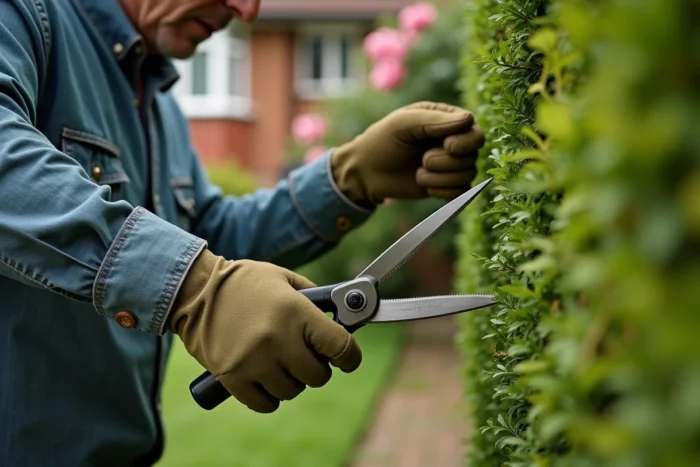
The trimming of hedges refers to the controlled cutting operation of the branches and twigs of a hedge to manage its shape, density, and height. This intervention directly affects the health of the shrubs, their ability to produce new vigorous shoots, and their role as a plant barrier. When done correctly, it also preserves the wildlife that nests in the vegetation.
Trapezoidal cutting profile: the technique that prevents thinning
A hedge trimmed in a rectangular block always ends up thinning at the base. The reason is simple: the upper branches, being wider, cast shade on the lower twigs, which receive too little light to produce foliage.
The trapezoidal cutting profile corrects this problem. The principle is to trim the hedge narrower at the top than at the base, with a slight incline on each side. The sun then reaches the entire height of the plant, and the density remains uniform from the ground to the top.
To achieve this profile, place a taut line between two stakes at the desired height, then tilt your blade a few degrees inward as you go up. A useful visual guide on trimming shapes and choosing the right equipment can be found at sculpte-haie.com, which details cutting geometries according to species.
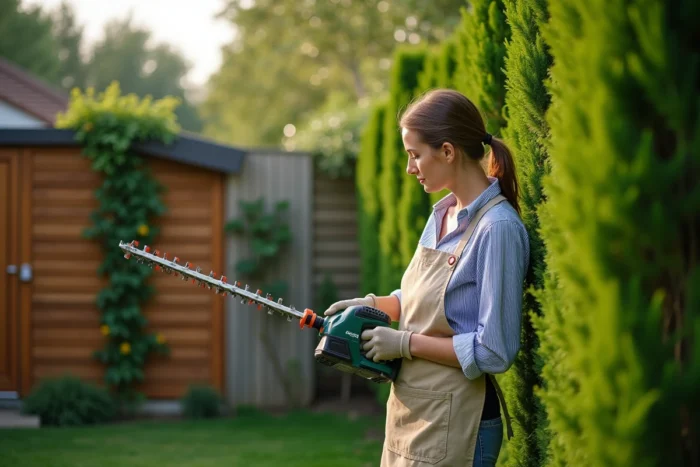
This profile works particularly well on conifer hedges (thuja, Leyland cypress), whose old wood does not regrow. On these species, cutting into dead wood does not generate any regrowth: it is better to prevent thinning than to try to correct it afterward.
Trimming schedule and nesting protection
The choice of trimming period is not solely based on plant vigor. The Common Agricultural Policy (CAP) prohibits farmers receiving aid from trimming their hedges between March 16 and August 15, to protect bird nesting.
This prohibition does not legally apply to individuals. However, nature protection associations like the LPO relay these dates as strong recommendations for all gardens. Trimming between mid-March and mid-August potentially destroys active nests, with ongoing broods in the majority of dense hedges.
In practice, two trimming windows emerge:
- The main trimming at the end of winter (February to early March), before the buds break and before the nesting period, to give the overall shape.
- The finishing trim at the end of summer (September), once the chicks have fledged, to correct the growth of the year and regain a clean profile before autumn.
- A light pass in December is still possible on evergreen hedges, outside of frost periods, to correct isolated shoots.
Before each intervention, inspect the hedge at eye level and at ground level. A blackbird or robin’s nest can be easily spotted if one takes a few minutes to observe.
Legal height of hedges: Article 671 of the Civil Code
Article 671 of the Civil Code sets the rules for distance and height for plantings at property boundaries. Any hedge exceeding 2 m in height must be planted at least 2 m from the separating fence. For hedges of 2 m or less, the minimum distance drops to 50 cm.
A lesser-known mechanism complicates the situation: the thirty-year prescription. If a hedge has exceeded the legal height for more than 30 years without the neighbor having made a written objection or initiated legal action, the owner of the hedge acquires the right to keep it as is.
This prescription protects old hedges, but it also makes neighborhood disputes more complex. Keeping dated photographs of the hedge, or any written exchanges with the neighbor, is a useful precaution in case of future disputes.
Choosing the trimming tool according to the type of hedge
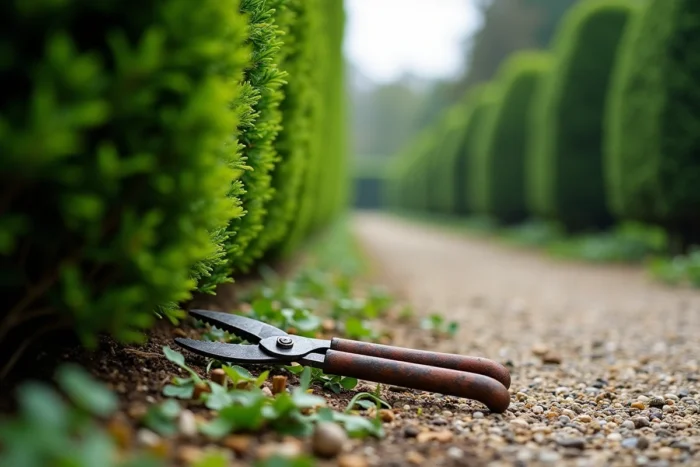
The equipment determines the quality of the cut and the accumulated fatigue. Three categories of tools cover the majority of situations:
- The manual shears are suitable for low hedges (boxwood, lavender) and precision touch-ups. They provide a clean cut without vibration but become exhausting beyond a few linear meters.
- The wired electric hedge trimmer remains the lightest and least expensive for medium-sized hedges near a power outlet. Its limit: the range imposed by the extension cord.
- The battery-powered hedge trimmer eliminates the constraint of the cord and offers freedom of movement comparable to thermal models, with a significantly lower noise level. The autonomy varies according to the battery capacity but is generally sufficient for a standard residential hedge.
- The thermal hedge trimmer is essential for long hedge lengths or thick branches. Its cutting power is superior, at the cost of increased weight and noise.
The blade length determines the width of the cut in one pass. A short blade (about 45 cm) favors maneuverability in corners and complex shapes. A long blade (60 cm and more) speeds up work on straight hedges.
Regardless of the tool, sharpen or have the blades sharpened at least once per season. A dull blade crushes the twigs instead of cutting them, leaving irregular wounds conducive to fungal diseases.
Hedge trimming is based on a few stable principles: a narrower profile at the top than at the bottom, a schedule that respects nesting wildlife, and a tool suited to the thickness of the branches. A well-maintained hedge gains density each year instead of gradually thinning, which reduces the necessary work in the long term.