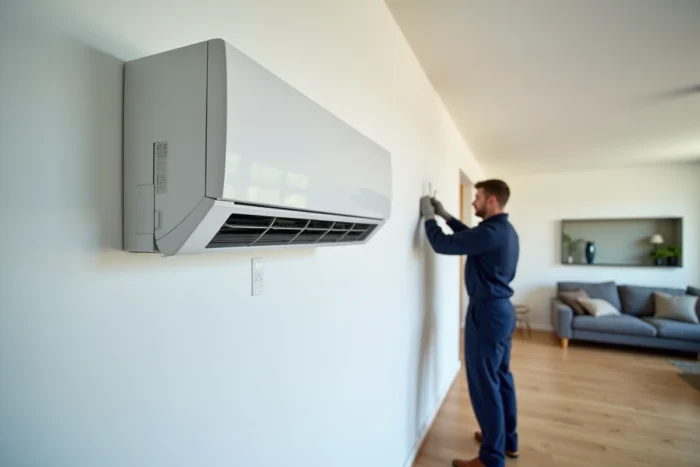
Air conditioning a 100 m² house does not cost the same whether you cool three rooms or the entire home. The difference between an entry-level system and a ducted installation can range from simple to tenfold. Before requesting a quote, it is essential to understand what drives up the bill, and especially what can be avoided.
Why the price varies so much depending on your home’s configuration
Two 100 m² houses located on the same street may require very different installations. The first, well-insulated, with open rooms and few south-facing windows, will require moderate power. The second, poorly insulated, with five closed rooms and large glazed areas, will require more units and significantly higher power.
What price comparisons do not always show is that the surface area alone does not determine the necessary power. One must consider sunlight exposure, ceiling height, wall insulation, and room distribution. An L-shaped house with a narrow hallway cannot be air-conditioned like an open-plan space.
To realistically estimate the cost of air conditioning for 100m², it is necessary to cross-reference the type of system, the number of targeted rooms, and the quality of the building’s insulation. Without these three data points, any price range remains approximate.
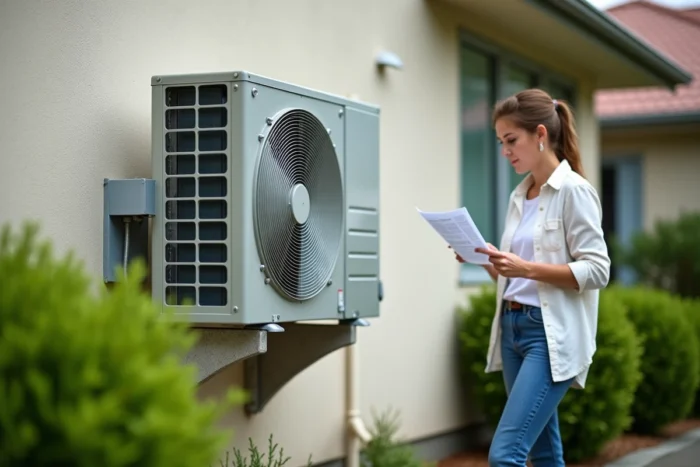
Multisplit, ducted, or monobloc: what each system really costs
You have probably come across these three terms in your research. Here’s what they concretely imply for a 100 m² house.
The multisplit: the most common choice
A multisplit system connects one outdoor unit to several indoor units, each installed in a room. To cover an entire 100 m² house, four to five indoor units are generally recommended. The multisplit offers room-by-room control, allowing you to turn off unoccupied areas.
The cost, including materials and installation, falls within a mid-range, but it quickly rises with the number of splits. Each additional indoor unit involves wall drilling, running refrigerant lines, and sometimes false ceilings.
The ducted system: discreet but more expensive
Ducted air conditioning distributes air through ducts hidden in false ceilings or attics. No visible units in the rooms, just air vents. It is the most aesthetically pleasing solution but also the most costly. Ducted installation requires a network of ducts and sufficient technical space, making it complicated for renovations.
The monobloc: more of a temporary solution than a lasting one
A portable monobloc air conditioner requires no fixed installation. However, its power remains limited and its efficiency poor over a large area. For 100 m², several units would be needed, resulting in a cumulative noise level that is uncomfortable. This option makes sense for temporarily cooling a single room, not for air conditioning an entire home.
Should you air-condition the whole house or target key rooms?
Why pay for five splits when three are sufficient? This question deserves to be asked before any request for a quote.
In most cases, air conditioning the living room, open kitchen, and bedrooms covers actual needs. Hallways, bathrooms, and storage rooms benefit from natural diffusion cooling. Targeting three or four rooms significantly reduces installation costs, sometimes by more than a third compared to full coverage.
Air conditioning the entire home is justified in specific situations:
- Single-story house in a very hot area, where each room exceeds the comfort threshold for several months
- Home with insufficient insulation that allows heat to penetrate everywhere, including north-facing rooms
- Professional activity at home in a room usually not air-conditioned (office, workshop)
Outside of these cases, a well-sized partial system offers comparable comfort for a more controlled budget.
Cost of installation by a professional and financial aid in 2026
Materials rarely account for more than half of the total budget. The installation itself depends on the complexity of the project: length of refrigerant lines, number of penetrations, accessibility of attics, and possible electrical upgrades.
A certified RGE (Recognized Environmental Guarantee) installer is essential to benefit from financial aids. Labor benefits from a reduced VAT of 10% when the property is over two years old and the installation is carried out by a qualified professional. The CEE (Energy Savings Certificates) grant can also reduce the remaining costs, subject to income conditions and equipment performance.
Requesting at least two or three detailed quotes remains the best way to compare. A serious quote distinguishes the cost of materials, labor, additional supplies (supports, cables, condensates), and any commissioning fees.
Reversible air conditioning: an investment for heating and cooling
The current trend leans towards reversible systems, capable of heating in winter and cooling in summer. An air-to-air heat pump operates exactly on this principle. The additional cost at purchase compared to a cooling-only system remains moderate, while the year-round use radically changes profitability.
A reversible system can replace an electric supplementary heater in the transitional seasons, reducing the overall energy bill. This “hot and cold” positioning explains why installers are increasingly steering quotes towards this option.
Some criteria to check before validating a reversible air conditioning quote:
- The announced coefficient of performance (COP), which measures the ratio of energy produced to energy consumed
- The noise level of the outdoor unit, especially in a semi-detached house or with close neighbors
- The manufacturer’s warranty on the compressor, the most expensive part to replace
- The compatibility with an annual maintenance contract, mandatory for systems containing more than 2 kg of refrigerant
The budget for air conditioning a 100 m² space depends less on the surface area itself than on technical choices and the number of rooms actually treated. Accurate sizing, performed by a qualified installer after visiting the property, remains the only way to obtain a reliable estimate. It is better to have a well-calibrated system for four rooms than an oversized installation that runs idle.