Customizing a garment means choosing a textile printing process even before thinking about the visual design. Each printing technique imposes its own constraints regarding fabric, colors, and production costs. This guide compares the main methods based on measurable criteria to help make a choice suitable for the medium, volume, and expected outcome.
Comparison of textile printing techniques: screen printing, DTG, DTF, sublimation, and embroidery
| Technique | Compatible fabrics | Ideal quantity | Color rendering | Wash durability | Unit cost in small series |
|---|---|---|---|---|---|
| Screen printing | Cotton, polyester, blends | Medium to large series | Vibrant colors, possible texture effects | Very high | High (fixed stencil costs) |
| DTG (Direct to Garment) | Mainly light cotton | Small series, unique piece | High definition, precise gradients | Medium to good | Moderate |
| DTF (Direct to Film) | Cotton, polyester, nylon, blends | Small to medium series | Intense colors, opacity on dark textiles | Good | Moderate |
| Sublimation | Polyester or white fabric with high polyester content | Small to large series | Full-color printing without relief | Very high (ink in the fiber) | Low to moderate |
| Embroidery | All sufficiently dense textiles | Small to medium series | Limited (colored threads, no gradient) | Excellent | High (stitching time) |
This table highlights the significant differences. The following sections analyze the criteria that shift a choice from one technique to another, beyond just the visual aspect.
To delve deeper into the specifics of each process, you can visit the Mamzelle H website to discover which details the particularities of these methods.
Fabric compatibility and printing technique: the criterion that many overlook
The type of textile influences the method far more than the budget or volume. A polyester treated with DTG will yield a dull and less durable result. Conversely, sublimation on cotton simply does not work, as the ink needs synthetic fibers to adhere through heat.
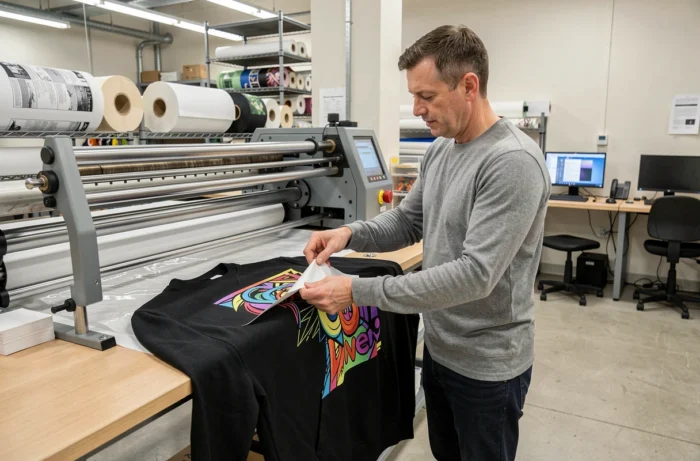
DTF stands out as the most versatile technique on various fabrics. Cotton, polyester, nylon, blends: the transfer film adheres to most textile surfaces without requiring a precise composition. This makes it a reliable fallback solution when the final medium is not yet defined at the time of order.
Embroidery, on the other hand, requires a sufficiently dense weight to withstand the tension of the needle. A fabric that is too thin will deform, pucker, and the design will lose sharpness. Polos and sweatshirts are well-suited for this. Lightweight t-shirts, much less so.
Sublimation: graphic freedom under textile constraints
Sublimation offers a photographic rendering without relief or texture on the garment. The ink penetrates directly into the polyester fiber under heat, making the print almost undetectable to the touch. However, sublimation requires a white or very light textile with a high polyester content. On dark cotton, the result will be invisible or faded.
This process is suitable for sports jerseys, technical t-shirts, and promotional textiles based on polyester. For an organic cotton sweatshirt, one should turn to DTG or DTF.
Textile screen printing and special effects: beyond standard visuals
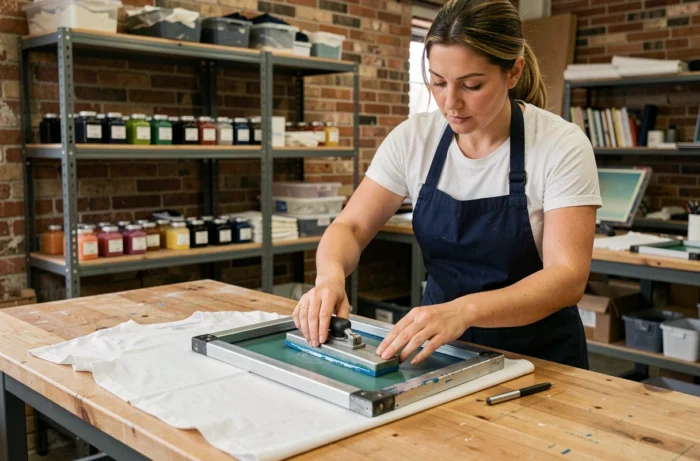
Screen printing is often reduced to its advantage in large series. Its true differentiating asset lies elsewhere: puff, silicone, high-density, and metallic finishes remain inaccessible to digital processes. These material effects create relief, texture, or shine that neither DTG nor DTF can reproduce.
A puff ink logo expands under heat to give a 3D effect. Silicone ink produces a smooth and soft touch that withstands repeated washes. These finishes place screen printing in a premium category that digital methods do not reach.
- Puff ink: raised puff effect, suitable for logos and lettering on thick sweatshirts and t-shirts
- Silicone ink: elastic and silky touch, good mechanical resistance on sportswear
- High-density ink: dense and sharp relief, used for geometric or typographic designs
- Metallic ink: golden or silver reflections, reserved for small surfaces to avoid rigidity
These effects require the creation of dedicated stencils (one for each color and effect), which increases production costs for small quantities. On an order of a few dozen pieces, the additional cost per unit remains significant.
Care and ironing behavior: what changes after the first wash
The appearance upon leaving the workshop does not always predict longevity. Some techniques react poorly to the heat of an iron or the friction of a dryer, and this aspect is rarely detailed during the initial choice.
Sublimation withstands washing very well since the ink is part of the fiber. No cracking, no peeling. However, ironing at too high a temperature on certain polyesters can alter the shine of the design.
DTF and flocking deposit a film or adhesive on the surface of the textile. This film can gradually peel off in areas of friction (collar, side seams). Ironing a DTF transfer inside out significantly extends the lifespan of the design.
Embroidery is not affected by heat or washing. The dyed threads retain their color over time. The only risk concerns decorative metallic threads, which may tarnish after many cycles.
- Screen printing: inside-out washing recommended, resists repeated cycles without significant color loss
- DTG: sensitive to frequent washes, prone to cracking after several dozen cycles
- DTF: avoid high-temperature tumble drying, iron inside out
- Sublimation: very stable in washing, caution with direct high-temperature ironing
Production volume and unit cost: where the tipping point lies
Screen printing becomes cost-effective from a certain volume because fixed costs (creation of stencils, color setup) are amortized over the number of pieces. For an order of a few units, the unit cost skyrockets.
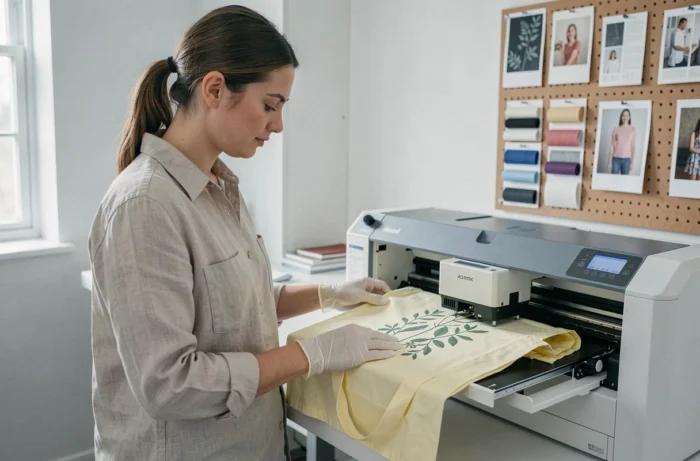
DTG and DTF have no minimum order, making them suitable for unique pieces or small series of customization. The unit cost remains stable whether printing one or thirty pieces.
Embroidery charges based on the number of stitches and stitching time. A complex design with multiple thread colors costs significantly more than a simple monochrome logo. The machine time per piece also limits the production rate.
The choice of a textile printing technique relies on a trade-off between three variables: the fabric of the garment, the order volume, and the type of desired rendering. A cotton t-shirt in a small series points towards DTG. A batch of polyester jerseys leans towards sublimation. A sweatshirt with a raised logo justifies screen printing.
Starting with the fabric and volume, not the catalog price, remains the most reliable method to avoid unpleasant surprises at delivery.