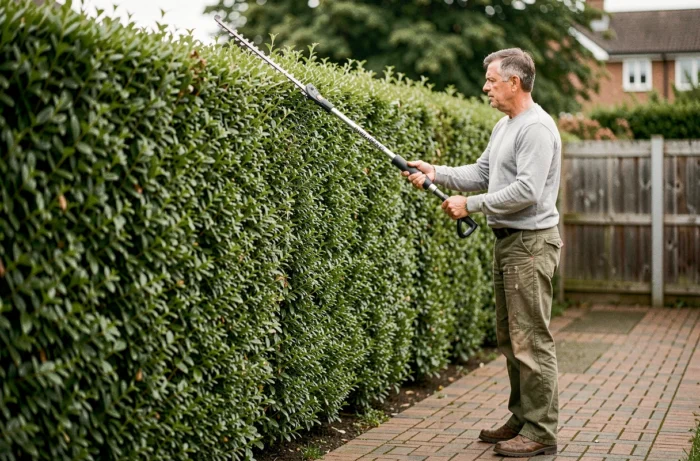
A telescopic hedge trimmer is a cutting device mounted on an extendable pole, designed to reach the top of hedges without using a ladder. Its uniqueness compared to a traditional hedge trimmer lies in the distance between the operator and the blade, which profoundly alters the tool’s balance, the fatigue felt, and the quality of the cut achieved at height.
Swivel head and balancing: what really matters in a telescopic hedge trimmer
Most guides compare models based on pole length and motor power. These two criteria are important, but they obscure a more decisive factor for working at height: the angle of the cutting head and the overall balance of the device.
A swivel head allows for trimming the top of a hedge while keeping the arms in a natural axis. Without this tilt, the user compensates by raising the tool almost vertically, which increases muscle fatigue on the shoulders and forearms. The most operational models offer several tilt positions, sometimes with a locking mechanism.
The weight displayed on the technical sheet does not reflect the perceived weight in real conditions. A device of the same mass can feel much heavier if its center of gravity is shifted towards the cutting head. Some manufacturers integrate a counterweight at the rear handle or provide a shoulder harness.
This harness is not a secondary accessory: during a trimming session of more than half an hour, it radically changes comfort. The resources available on taille-haie-telescopique.com detail these differences in balance between models.
Tooth spacing and branch diameter: the trap of underestimation
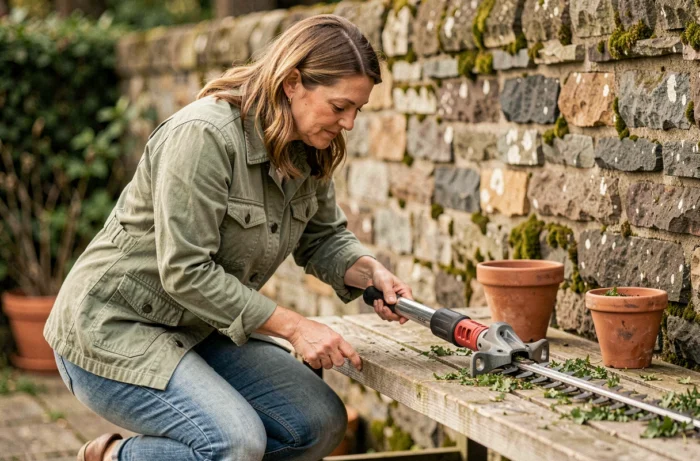
The spacing between the teeth of the blade determines the maximum diameter of branches that the tool can shear cleanly. Spacing that is too narrow compared to the branches actually present in the hedge causes repeated blockages. The blade gets stuck, the user forces it, and the motor overheats.
On a regularly trimmed laurel or privet hedge, this year’s shoots rarely exceed one centimeter in diameter. Standard spacing is sufficient. However, an unmanaged wild hedge left for two seasons produces significantly thicker branches. Tooth spacing suitable for the actual diameter of the branches prevents blockages and preserves the mechanics.
Double-action blades (both blades move simultaneously in opposite directions) reduce vibrations and improve cutting sharpness. This type of blade is particularly appreciated on a telescopic tool, where the distance between the hand and the cutting area makes any vibration more noticeable.
Telescopic alone or combination of pole and standard hedge trimmer
A telescopic hedge trimmer excels in a specific situation: trimming the top of a tall hedge from the ground. For this task, no other tool competes in terms of safety and accessibility.
The limitation appears on the sides of the hedge. Working on the sides with a pole-mounted device requires holding the tool at an angle, with a considerable lever arm. Precision decreases, fatigue increases, and the result is often less clean than with a traditional hedge trimmer held at waist height.
For a hedge exceeding two meters in height, combining two tools can prove more effective than a single telescopic:
- A traditional hedge trimmer (corded or battery-operated) for the sides, held at arm’s length or from a low step stool, offers superior maneuverability and finish
- The telescopic is reserved for the top of the hedge, where its pole provides a real advantage in reach and safety
- This distribution reduces overall fatigue because each tool is used within its optimal comfort range
The telescopic becomes less relevant as a standalone tool as soon as the hedge requires careful work on the sides. If the budget allows, owning both tools yields a cleaner result with less effort.
Battery, corded, or gas-powered: choose according to terrain configuration
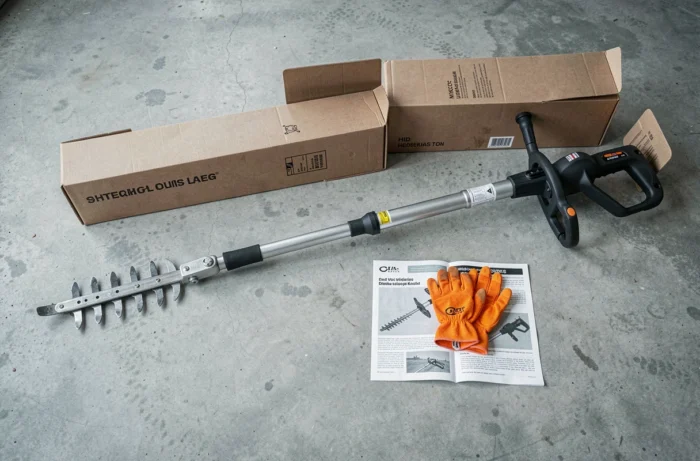
The type of power supply determines autonomy, weight, and range. On a telescopic, these constraints weigh more than on a traditional model because every extra gram is felt at the end of the pole.
- Models with lithium-ion batteries offer total freedom of movement and reduced noise levels. Autonomy varies according to battery capacity: ensure it covers the actual duration of the trimming session, knowing that working at height puts more strain on the motor
- Corded models are lighter (no built-in battery) and never run out of power, but the extension cord limits the range and poses a safety issue if the hedge is adjacent to a pathway
- Gas-powered models deliver superior power, suitable for very dense hedges or professional use. However, the weight, noise, and vibrations make them less comfortable for an individual who trims two or three times a year
Safety at height: the constraint of power lines
Trimming at height with a metal or semi-metallic pole near overhead power lines poses a real risk. The most comprehensive operational guides include this check as a prerequisite, not as a trivial precaution.
Before any session, identify the path of cables above or in close proximity to the hedge. Maintaining a sufficient safety distance from any power line is a non-negotiable constraint. If the hedge grows directly under a cable, contact the network manager or hire a professional equipped for the task.
Lastly, a point often overlooked: the trimming period. The French Office for Biodiversity recommends avoiding any trimming from March 15 to July 31 to protect bird nesting. This is a schedule to integrate before even taking the tool out of the garage.