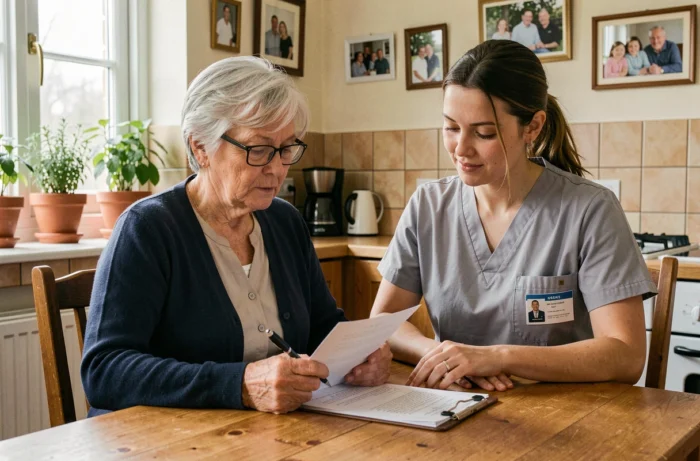
When helping a parent organize their days after hospitalization, the difficulty is not in finding a service, but in understanding which one truly corresponds to their situation. Between traditional home help, coordinated nursing care, and respite care for caregivers, the range of services dedicated to seniors has significantly expanded in recent years, to the point of becoming difficult to decipher.
Home autonomy services: what the SAD reform changes for seniors
Since 2023, the former acronyms SAAD, SSIAD, and SPASAD are gradually disappearing in favor of Home Autonomy Services (SAD). Two categories now coexist: SAD “help” and SAD “help and care.” Compliance is expected by the end of 2025 at the latest.
In practice, this merger has a direct impact on the choice of a provider. A SAD “help and care” can coordinate the interventions of a caregiver and a nurse within the same structure. Before this reform, it was often necessary to juggle between two distinct organizations, with schedules rarely synchronized.
To verify the exact category of a service, one can consult the senior information on Le Journal du Senior, which allows you to identify the referenced structures and their scope of intervention. The key point to remember: always ask if the chosen SAD also includes care, especially when an elderly person is discharged from the hospital and needs nursing follow-up alongside daily assistance.

Territorial resource centers: a solution when traditional home care is no longer sufficient
These are rarely discussed, and families often discover them too late. Territorial Resource Centers (CRT) cater to seniors whose loss of autonomy exceeds what usual aids can cover, but who do not wish to enter an institution.
In concrete terms, a CRT offers enhanced support: medical coordination, psychological support, adapted activities. It lies between traditional home services and nursing homes, an area where many families find themselves without a clear solution.
When to refer to a CRT rather than a SAD
The most common warning sign is the multiplication of caregivers without visible results. If, despite home help, meal delivery, and nursing visits, the person continues to deteriorate (repeated falls, increasing isolation, malnutrition), the CRT can provide a more structured framework.
The challenge remains access: these centers are not evenly distributed across the territory. One must inquire with the municipal CCAS or the departmental council to find out if a CRT exists nearby.
Tax credit and immediate advance: easing the cost of personal services
The cost of home services remains a major barrier. Many seniors and their families are unaware that the immediate advance of the tax credit reduces the bill upon payment, without waiting for the income declaration. This mechanism applies to personal services: cleaning, shopping assistance, administrative support.
Direct employment after 70: a change to know
For seniors aged 70 to 79 who directly employ a home helper (without going through a service provider), costs may have increased since 2026. The exemption from employer contributions, which was previously broader, has been restricted for this age group. Individuals aged 80 and over are not affected by this measure.
Before choosing between direct employment and a service provider, it is essential to compare the net cost after the tax credit in both cases. Here are the criteria to consider:
- The gross hourly rate of the provider, checking if it includes social charges and management fees
- The actual amount of the exemption from contributions based on the age of the person receiving assistance (the rule differs before and after 80 years)
- The possibility of activating the immediate advance via the CESU, which reduces the monthly out-of-pocket expenses without advancing the total
- The coverage in case of the caregiver’s absence: an organization generally ensures replacement, not direct employment

Respite for family caregivers: the systems that are being structured
Supporting an elderly parent on a daily basis generates a fatigue that families almost always underestimate. Caregiver respite is receiving increasing regulatory attention. In 2026, the CNSA selected new experimental projects to outline a national respite pathway.
This is still considered an exploratory approach, not a generalized system. Feedback varies depending on the territories and the structures involved. What already exists and works:
- Day care, which allows the elderly person to spend a few hours in an adapted structure while the caregiver takes a break
- Temporary accommodation in a nursing home or assisted living facility, for stays ranging from a few days to a few weeks
- The right to respite, funded by the APA, which can cover part of the cost of these solutions
A common pitfall: waiting until complete exhaustion before seeking a solution. Anticipating the request for day care or temporary accommodation avoids waiting lists that, in some departments, can reach several months.
Adapting seniors’ housing: where to start concretely
Home modifications do not just involve installing a grab bar in the shower. Occupational therapists who work at home assess risks room by room: bed height, corridor lighting at night, slippery floor coverings, accessibility of everyday storage.
Funding often comes through several simultaneous channels: the APA for GIR 1 to 4, Anah aids for adaptation work, and sometimes supplements from pension funds. A single file does not yet exist, which requires submitting several requests in parallel. The CCAS or a specialized social worker can centralize the procedures and avoid duplicates.
The choice between staying and moving should be made early. A multi-story home without the possibility of installing a stairlift, or located far from any shops, will ultimately cost more in compensatory services than moving to an adapted home. The question is not sentimental; it is budgetary and logistical.