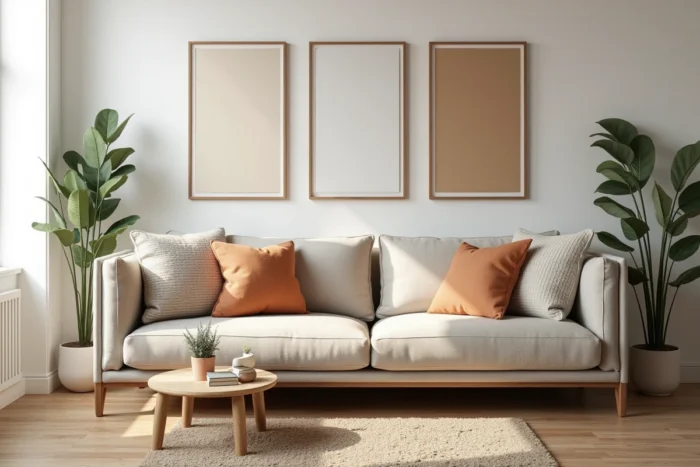
Furnishing a house with style doesn’t necessarily require a big budget or an interior designer. A few thoughtful choices regarding colors, materials, and furniture arrangement are often enough to transform a space. The real lever is the coherence between what you see, what you touch, and what you feel when entering each room.
Textured materials and warm colors: the foundation of a coherent home decor
Have you ever noticed that some interiors seem welcoming at first glance, even if you can’t quite put your finger on why? The answer often lies in the materials. Washed linen on a sofa, a raw wood tray on the coffee table, a boucle wool rug underfoot: these textures send a signal of comfort even before you sit down.
The current trend in interior decoration goes in this direction. We increasingly talk about slow decor: decorating less but with sustainable materials. All-white minimalism is giving way to more embodied tones, such as sandy shades, greige, or wood browns. These colors are less tiring to the eye than pure white, especially in living spaces where we spend several hours.
Specifically, start with the living room. Choose a neutral dominant tone for the walls (a warm beige, a soft gray) and add depth with cushions or a throw in a more vibrant color. Jewel tones (wine, gold, emerald) are making a strong comeback for accessories. One or two color accents per room are enough to avoid visual overload.
To explore other avenues for furnishing and decorating your home, you can check out the Verita Press website, which gathers ideas organized by room and style.
Furniture arrangement in the living room: circulation changes everything
A poorly placed piece of furniture can make an entire room uncomfortable. Before thinking about wall decor or lighting, ask yourself a simple question: can I walk through my living room without navigating around an obstacle?
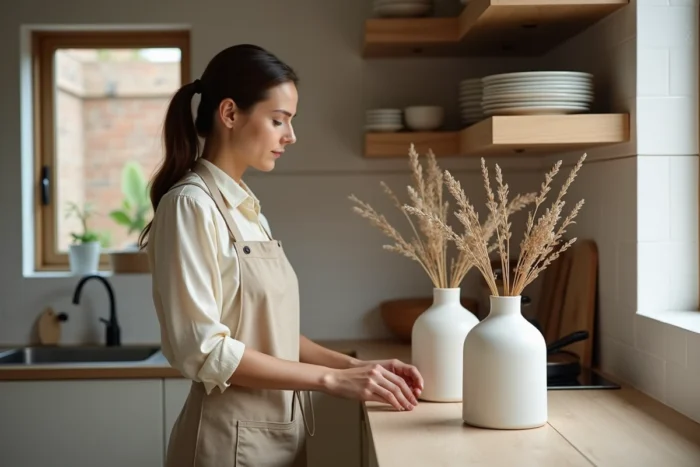
The sofa sets the tone for the entire living space. Place it first, oriented towards the focal point of the room (fireplace, large window, TV unit). The rest of the furniture organizes around it. A common mistake is to push all the furniture against the walls. In a medium-sized living room, moving the sofa a few inches forward creates a circulation space behind it and gives an impression of volume.
Keep a passage free of at least one person’s width between each area. If you’re unsure about the arrangement, tape out a floor plan before moving anything. Five minutes of testing is better than an hour of rearranging.
The trap of forced symmetry
Two identical armchairs facing the sofa, two identical lamps on the console: perfect symmetry works in magazines, rarely in real interiors. A slight offset makes the space more lively and personal. For example, pair a velvet armchair with a rattan chair. Controlled asymmetry is a styling tool that professional decorators systematically use.
Natural and artificial light: two distinct levers for interior decoration
Light changes the perception of colors, volumes, and even materials. A greige wall will appear warm in natural light and dull under a white neon. Working on lighting is working on decor.
For natural light, the principle is simple: don’t block it. Cotton or linen gauze curtains filter without darkening. If your room lacks brightness, a large mirror placed opposite the window reflects light into the depth of the living room.
Multiply light sources rather than relying on a single central ceiling fixture. A reading lamp near the sofa, a low pendant above the dining table, indirect lighting behind a piece of furniture: each light point creates a different ambiance depending on the time of day. Warm shapes, in fabric or frosted glass, are gradually replacing cold metallic fixtures in current trends.
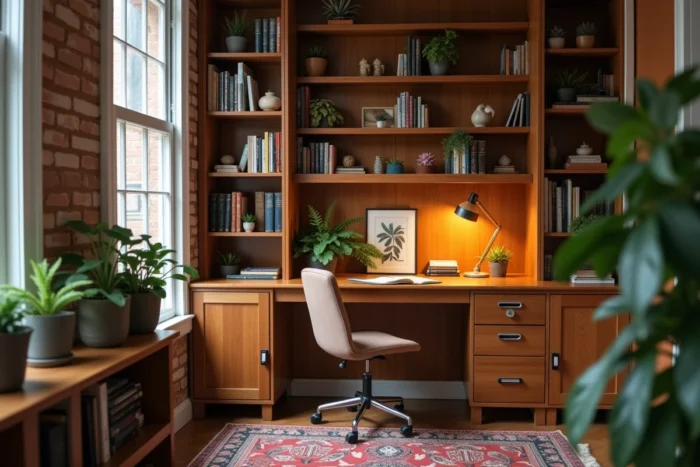
Adjusting color temperature
Light bulbs have a temperature measured in kelvins. For the living room and bedrooms, stick to warm tones. For the kitchen and office, a more neutral light facilitates concentration. The right bulb changes the atmosphere as much as a coat of paint.
Creating a sound and sensory cocoon at home
Decoration isn’t just about appearance. The acoustic comfort of a room directly influences the well-being felt. Specialized sources describe the emergence of the concept of “home bubble”: an interior designed as a complete sensory cocoon, where sound insulation, soft textures, and soothing colors converge to reduce nervous fatigue.
A few concrete adjustments can improve acoustics without heavy work:
- A thick rug absorbs footstep noises and reverberations, especially on tiled or floating wood floors.
- Heavy cotton or lined linen curtains dampen sounds coming from outside while dressing the window.
- A filled bookshelf against a shared wall acts as a natural sound buffer, in addition to its decorative role.
Combining these elements in one room produces a cumulative effect that is noticeable. The space becomes quieter, more enveloping, without altering the building’s structure.
Decorating with sustainable materials: a choice of style as well as ethics
Slow decor is not limited to aesthetics. Choosing sustainable materials (solid wood, ceramics, stone, full-grain leather) has a direct impact on the longevity of your furnishings. A solid wood piece ages beautifully over time. A laminated particle board piece deteriorates.
The true cost of a piece of furniture is calculated in years of use, not in purchase price. A linen and beech armchair kept for fifteen years costs less than a model replaced every three years. Before buying, ask yourself: will this piece of furniture still have a place in five years?
Accessible eco-friendly alternatives also exist for walls. Low-VOC paints, lime or clay-based coatings: these finishes bring a lively texture to walls while limiting emissions in indoor air.
Ultimately, furnishing and decorating a house with style rests on three pillars: materials you want to touch, smooth circulation in each room, and lighting suited to each use. The rest, decorative objects, frames, plants, naturally complements a space that is already well thought out.